
OB-Barometer 2026: Finances, housing and the economy are the biggest causes for concern
The importance of economic and labour market policy has increased, whilst the accommodation of refugees and climate protection have become less important. The views of city leaders differ very little between federal states and cities of different sizes.
According to the annual Difu survey of city mayors, “municipal finances” remain the most important current area of focus in their own city in 2026 – even more so than in 2025. This once again confirms the dire state of municipal finances, as evidenced by the financial shortfall faced by municipalities in Germany, which reached a record high of 31.9 billion euros in 2025.
According to Difu’s 2026 OB-Barometer, the provision of affordable housing remains – as in the previous year – the second most important issue for city mayors (36 per cent). The local economic situation has become significantly more important, even compared with last year; more than a third of city mayors cite “strengthening the economy, economic development, structural change and the economic cycle”. The continuing difficult economic situation, a shrinking industrial sector in many areas, the relocation of businesses and significant job losses are also increasing the pressure to act at municipal level. The topic of the economy has “swapped places” with “climate protection, energy policy, sustainability and the heating transition” – areas of action that only 20 per cent of city mayors now consider to be among the most important, compared with 30 per cent in 2025. This, too, represented a significant decline compared with previous years and peak figures, which had stood at over 60 per cent of responses just a few years ago.
Topics such as “smart city, digitalisation and broadband expansion” have become more important compared with 2025 (rising from 6 per cent to 14 per cent of responses), although city leaders did not explicitly mention the role of AI or the consequences of its increasing use.
For the first time, “tasks in the area of social services” (10 per cent) were cited by a large number of city mayors as one of the most important issues for their own city, particularly in light of the continuing rise in costs in this area. Expenditure has risen enormously in recent years, not only in child and youth welfare and integration support, but also in care. It is therefore fitting that, for the first time, demographic trends are now cited as one of the most important areas for action – particularly in East German cities – both now and in the future. More than a quarter of East German city mayors expect to face significantly greater pressure to take action in the area of healthcare and care over the next five years than their counterparts in the remaining federal states.
The views of city leaders on the current situation in their own city largely coincide with their views on the future. As a result, the topic “financial situation and budgetary consolidation” remains in first place (64 per cent) in terms of expectations for the next five years. Next comes “housing construction”; a third of city mayors regard this issue as a high priority. Strengthening the economy also remains a top priority for the next five years (32 per cent of responses; 2025: 25 per cent). “Climate adaptation, sustainability and climate change” are continuing to become less important: a trend that was already evident in 2025. In 2026, revitalising the city centre is once again mentioned more frequently, both as a current issue and as an important topic for the future. The transformation of city centres into liveable and sustainable places remains a priority, against the backdrop of the (uncertain) future of department stores, vacant shop premises and, in many places, declining footfall in city centres. For the first time, in 2026, city mayors identified the issues of “disaster control, civil protection and crisis management” (13 per cent), thereby responding to the current geopolitical situation and its implications for municipalities.
When it comes to the question of “crisis-related challenges”, the important role played by rising social spending becomes clear: according to the OB-Barometer, 91 per cent of city leaders regard this issue as one of the very significant or significant challenges facing municipal politics. For almost two thirds of city mayors, tax shortfalls and falling tax revenues are a challenge that is having an impact on the municipal budget. The investment required for digitalisation measures and projects continues to be regarded as a relevant challenge (85 per cent rated it as “very significant” or “significant”). Right-wing populism and scepticism towards democracy remain a considerable challenge; 84 per cent of city mayors confirm this. Implementing the heating transition continues to pose significant challenges for municipalities (82 per cent). Investment requirements also remain a major challenge in the areas of climate protection and climate adaptation (80 per cent rated this as “very significant” or “significant”, though only 21 per cent rated it as “very significant”).
The provision of accommodation for refugees has become significantly less important compared with previous years. Only 43 per cent of municipalities now regard this as a very significant (10 per cent) or significant (33 per cent) challenge. This is in line with the continuing decline in the number of asylum applications, which provides some initial relief for municipalities; however, the demands on housing, childcare and school infrastructure, and integration remain. Surprisingly, the issue of the freeze on the repurposing of Bundeswehr properties – which has received a great deal of attention in the press – is cited by only a few respondents as a challenge for their city.
In 2026, too, fiscal policy remains the area in which city leaders are most urgently calling for support from the federal states, the central government or the EU (85 per cent). Next comes “economic policy”, which has overtaken all other policy areas, including “housing policy”. City mayors are calling for more support in the area of labour market and employment policy (2026: 24 per cent, 2025: 16 per cent). Social, youth and family policies have gained in importance, in line with the significant pressure to both increase spending and make savings in the social sector. The growing significance of demographic change is also reflected here.
The financial situation, budgetary consolidation and inflation are issues that have taken on even greater importance in Difu’s 2026 OB-Barometer, both at present and with a view to the future. Demographic change is becoming increasingly important, particularly for cities in eastern Germany.
Background
Difu’s OB-Barometer is an annual survey of the mayors of German cities with a population of 50,000 or more. It is supported by the Association of German Cities (DST) and the German Association of Towns and Municipalities (DStGB), and its aim is to highlight changes in municipal policy areas at an early stage. The 2026 results are based on a representative telephone survey (14 January to 2 April 2026) carried out by infratest dimap on behalf of Difu. 121 of the 195 invited city mayors (including twelve deputies) took part. This corresponds to a participation rate of 62.1 per cent.
Dr. Beate Hollbach-Grömig
+49 30 39001-293
hollbach-groemig [at] difu [dot] de
Prof. Dr. Jochen Monstadt
+49 30 39001-214
monstadt [at] difu [dot] de
Sybille Wenke-Thiem
+493039001209
wenke-thiem [at] difu [dot] de
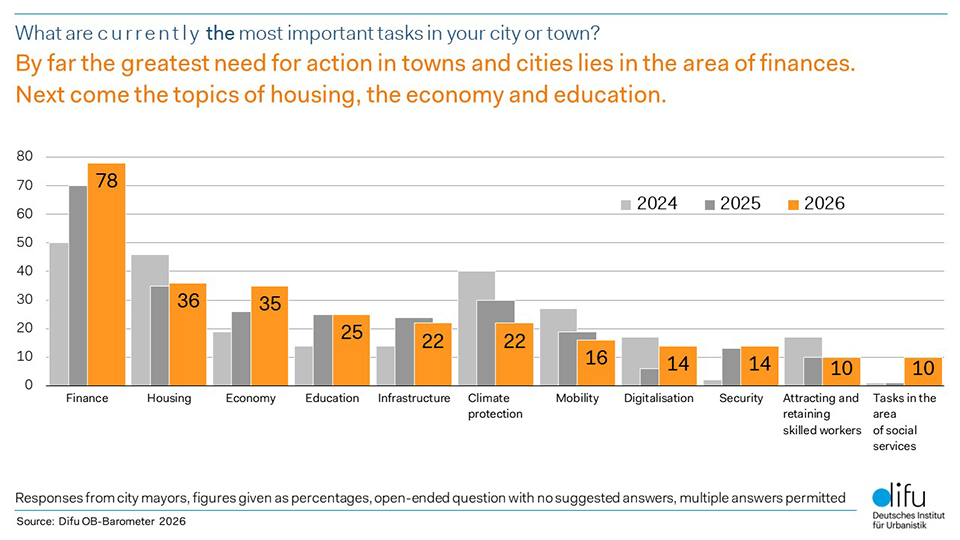
What are currently the most important tasks in your city or town?
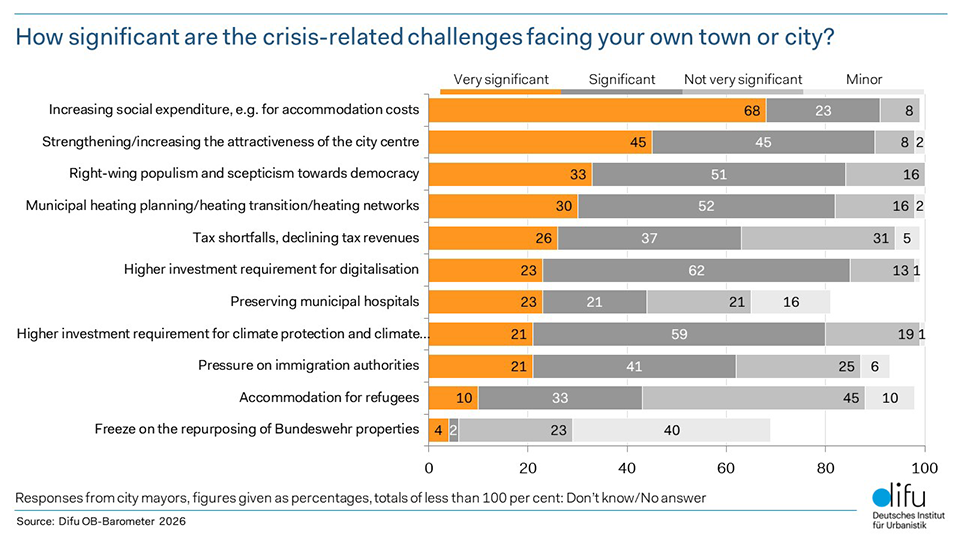
How significant are the crisis-related challenges facing your own town or city?