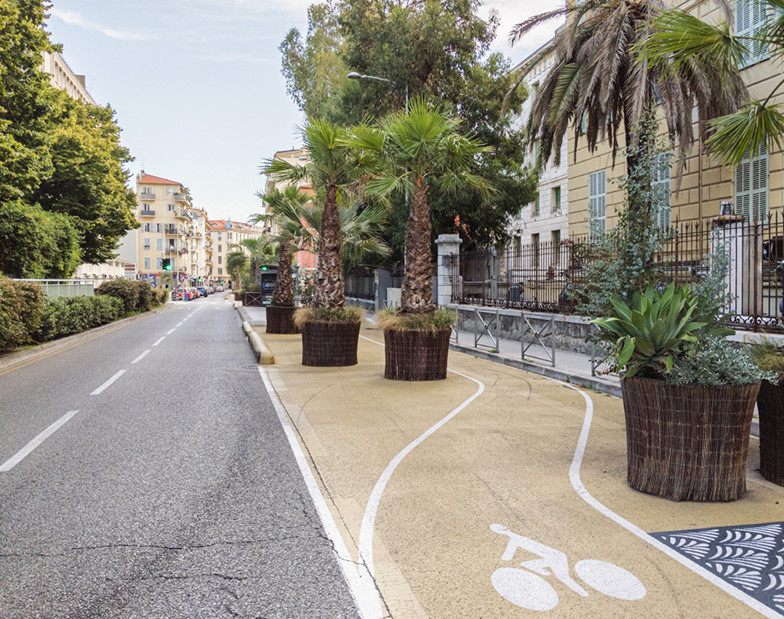
Designing Spaces, Resolving Conflicts: A Focus on the 15-Minute City
A 15-minute walk or bike ride to the supermarket, school, or work: In recent years, many cities have incorporated the concept of the 15-minute city (15mC) as a guiding principle in their planning. In addition to strategies for promoting urban density and diversity, the focus is primarily on reducing car traffic through car-free neighborhoods and the redesign of urban street space. Some of these measures have repeatedly been the subject of controversial debate in the past: for example, some oppose measures that restrict car access to inner-city neighborhoods, while others fear increased gentrification as a result of the revitalization of public spaces. To overcome these conflicts arising from urban transformation, cities are seeking solutions to extend the 15mC concept beyond the urban center and make it more socially inclusive. The research team behind the TuneTo15 project is addressing this issue by combining a quantitative accessibility analysis with a qualitative analysis of the social dimensions of conflict in four cities: Berlin, Hanover, Vienna, and Ljubljana..
The project objectives are:
- Identify the limitations and potential of the 15mC concept in various spatial contexts, particularly outside urban centers;
- Understand the concept’s impact on various social groups and identify conflicts among them;
- Involving local stakeholders to promote the implementation of the 15-minute city in various spatial contexts, develop conflict resolution strategies, and thereby strengthen the transformative capacity of local stakeholders.
TuneTo15 focuses on case studies in Berlin, Hanover, Vienna, and Ljubljana and their surrounding regions. All four cities have been pursuing ambitious transportation policies for years—and all have recently faced significant obstacles that have made implementation difficult (e.g., due to shifting political majorities). The case studies cover a range of metropolitan scales as well as spatial structures (monocentric versus polycentric). In each case study, an urban and a suburban neighborhood are selected as study sites. The findings are presented in the form of a practical guide for local government officials.
Technische Universität Wien;
Stadt Wien (MA 18 Stadtentwicklung und Stadtplanung);
S&W Stadt- Regionalforschung GbR;
Research Centre of the Slovenian Academy of Sciences and Arts, Anton Melik Geographical Institute;
Region Hannover;
Landeshauptstadt Hannover;
Berliner Senatsverwaltung für Mobilität, Verkehr, Klimaschutz und Umwelt;
Verein Fairkehrswende Wien;
Àrea Metropolitana de Barcelona;
Salzburger Institut für Raumordnung und Wohnen